

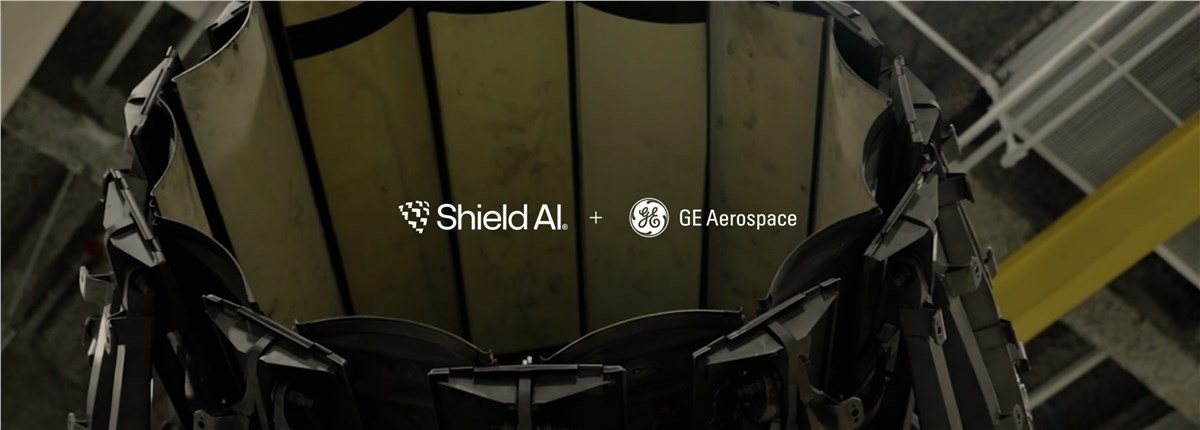
GE Aerospace and Shield AI have successfully completed integration, actuation and engine light-off testing of the advanced Axisymmetric Vectoring Exhaust Nozzle (AVEN) for Shield AI’s X-BAT aircraft, marking a milestone in the programme’s path to vertical flight.
Engineers from both companies modified and integrated the AVEN into GE Aerospace’s F110-GE-129E engine before completing functional checkouts and engine light-off to verify system performance at GE Aerospace’s test operations site in Peebles, Ohio. This represents the first fully integrated test campaign of its kind since the 1990s, bringing AVEN’s hardware, controls and engine systems together to execute coordinated nozzle movement sequences using defined test protocols.
“X-BAT is designed to take off and land vertically from anywhere — no airbase, no runway — and that capability lives or dies with propulsion,” said Armor Harris, Senior Vice President of Aircraft Engineering at Shield AI. “The AVEN is what makes vertical flight possible on a platform this size and this capable. We’re applying it differently than it was ever used before. Vertical flight requires fast gimbaling to maintain attitude control, a demand the original program never had to meet. Taking hardware with a flight-proven track record and adapting it for that mission has let us move through development at an incredible pace instead of starting from zero. Completing this integration in a short timeframe shows what these combined teams can do. The next step is iterating on our propulsion approach to make future versions faster, lighter, and more capable.”
The AVEN provides thrust vectoring capability for vertical flight, launch and landing. Originally designed for a multi-axis thrust vectoring programme that flew on an F-16 in the 1990s, the nozzle accumulated 73 hours of ground testing and 135 flight hours across 95 flights during its original development programme.
As part of the X-BAT programme, the hardware was refurbished and returned to operation. Following refurbishment, AVEN is undergoing ground testing in preparation for flight testing aboard the X-BAT prototype.
“The integration of AVEN into our F110-GE-129E engine and a successful light off represents a full-circle moment for our GE Aerospace team. By combining our proven experience in developing propulsion systems with Shield AI’s next-generation vehicle development, we are integrating the best of past, present, and future products to create a revolutionary aircraft,” said Doogie Russell, Vice President of Edison Works at GE Aerospace.
