

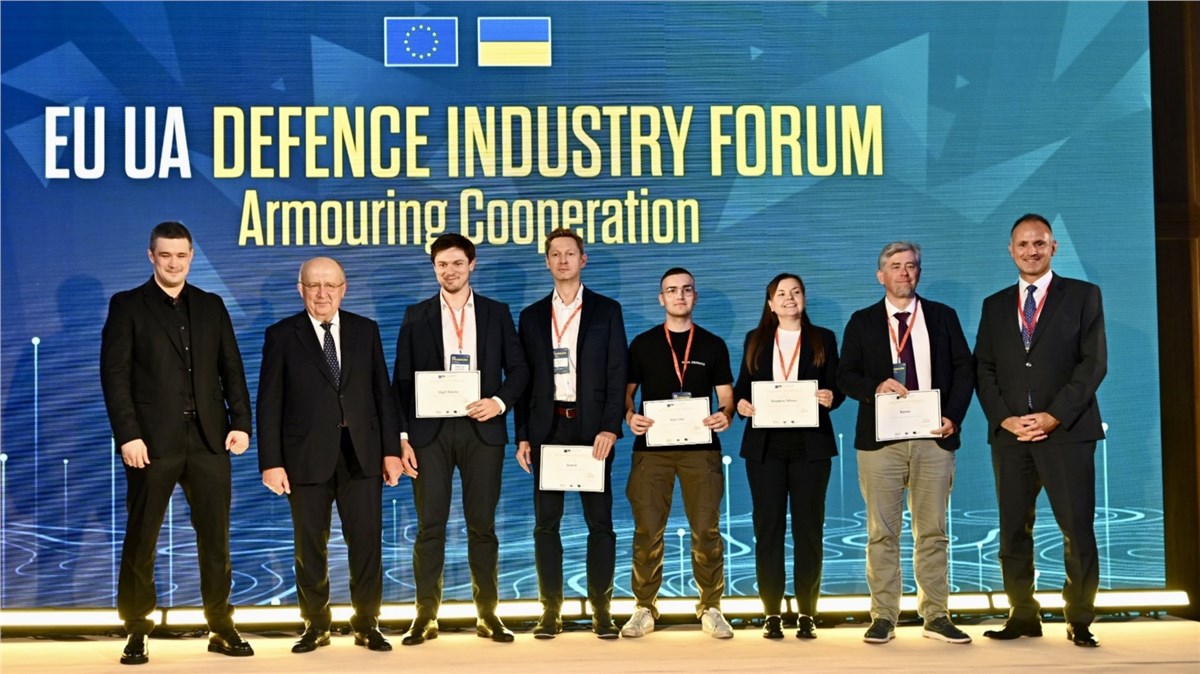
The European Commission, the European Defence Agency (EDA) and the Minister of Defence of Ukraine have announced in Kyiv six winners of the first-ever BraveTech EU Phase I. EDA will now work with the selected companies to experiment with their solutions in realistic operational conditions under BraveTech EU Phase II.
The winners successfully completed BraveTech EU Phase I, an intensive technology-testing programme that helped them advance their innovative solutions. During the next phase, EDA will guide the companies in further developing their technologies and experimenting in a battlefield-like environment. The operational experimentation will take place in parallel with the EU OPEX in Portugal and will generate evidence to support further technology maturation and potential military adoption.
“Innovation alone is not enough — it must be tested, trusted and rapidly turned into military capability,” said EDA’s Chief Executive André Denk at the award ceremony in Kyiv. “Through BraveTech EU, the European Defence Agency offers faster experimentation with operational rigour. By connecting innovation with real operational needs, we generate the trusted evidence that military users need to strengthen both Ukraine’s immediate defence requirements and Europe’s long-term defence readiness.”
The companies selected for experimentation under BraveTech EU Phase II are Soraccel of France, which develops complete multi-UAV systems based on hierarchical drone swarms; EdgeX Robotics of Poland, with its modular multi-role 4×4 unmanned ground vehicle (UGV) platform; Smaesh GmbH of Germany, developing a multi-radio mesh combining LoRa, Wi-Fi HaLow, Wi-Fi and BLE for resilient robotic and tactical connectivity; Kova Labs of Finland, developing cost-effective fully autonomous systems for complex low-altitude environments; Tempterno Defence of Estonia, with a multi-rocket launcher concept for counter-UAS and land-target engagement; and Rannon of Latvia, which develops rocket-propelled ammunition for drone-to-drone air combat.
During Phase II, each company will demonstrate its solution against scenarios refined together with EDA and Portuguese Army experts. These include multi-drone reconnaissance missions, unmanned ground vehicle support tasks and maintaining connectivity under deliberately degraded conditions. The companies will have the opportunity to operate their systems alongside EU OPEX participants.
Following the campaign in Portugal, the four most advanced technologies from BraveTech Phase II will continue experimentation in 2027.
