

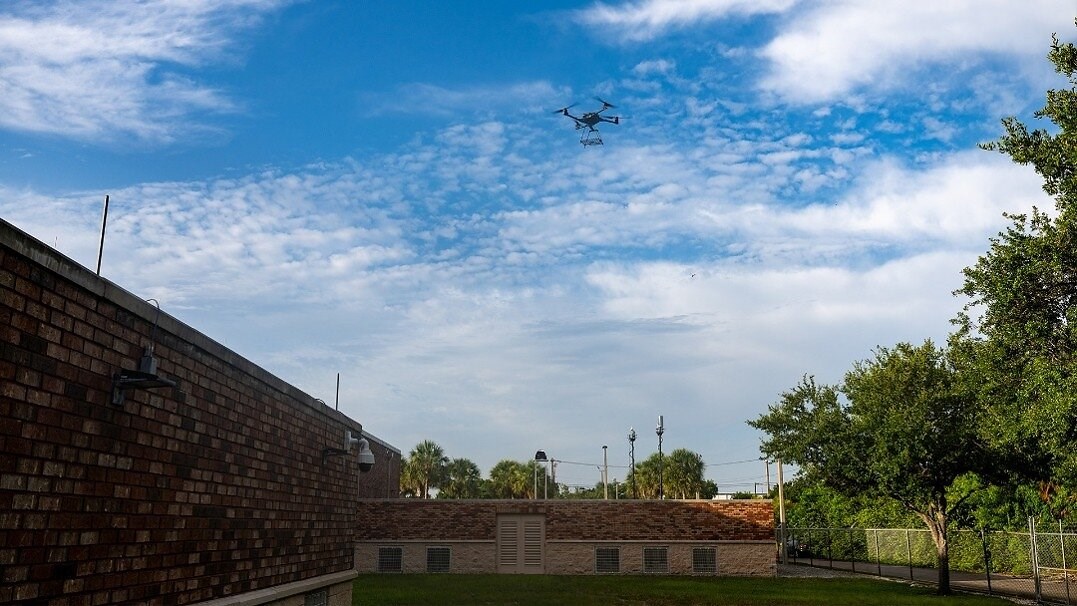
Lockheed Martin, in collaboration with Verizon, NVIDIA, Keysight Technologies, ODC, and Astris AI, has demonstrated how commercial off-the-shelf (COTS) technologies can make detecting and tracking unmanned aircraft systems (UAS) more accessible, faster to deploy, and easier to scale for public and critical infrastructure protection.
In a July demonstration in the Miami area, the NetSense Airspace Awareness-as-a-Service system demonstrated an AI-enabled capability capable of identifying, tracking, and monitoring UAS utilizing existing 5G networks. The technology has broad applications across critical infrastructure, large-scale events, utilities, schools, hospitals, and airports.
The successful live demonstration took place in a critical urban area, showcasing NetSense’s components and UAS detection systems in real time. Leveraging Verizon’s 5G network spectrum, ODC’s AI-native RAN software, NVIDIA’s AI Aerial platform, and Keysight’s RF simulation platform, NetSense detected drones and maintained track custody through the flight.
The NetSense solution combines Lockheed Martin’s warning and tracking systems using AI to read RF disturbances, predict UAS flight paths, and send real-time alerts. Key features include AI-native sensing, rapid deployment leveraging COTS, cost-effectiveness, open architecture for integration of new technologies, and scalability from single sites to mobile command and control.
The demonstration proved NetSense can sense UAS without changing existing cellular deployments, enabling cost-effective sensing without infrastructure recapitalization. NetSense will be delivered as a subscription service interfacing with customers’ security operations. Pilot deployments are planned for late 2026 and early 2027, with commercial availability in 2027.
Sarah Hiza, Senior Vice President of Technology and Strategic Innovation at Lockheed Martin, stated: “As drones become more affordable, airspace awareness technology needs to evolve rapidly. By working within established 5G networks, we can deploy a solution ready at the time of need.”
Anil Guntupali, Senior Vice President of Technology and Product Development at Verizon, added: “By applying AI to RF data traversing our 5G infrastructure, we can turn our network into an intelligent sensing platform.”
Ronnie Vasishta, Senior Vice President of Telecoms at NVIDIA, commented: “NVIDIA AI Aerial turns existing 5G infrastructure into an AI-powered sensing platform, enabling instantaneous RF analysis for faster detection and alerts.”
