

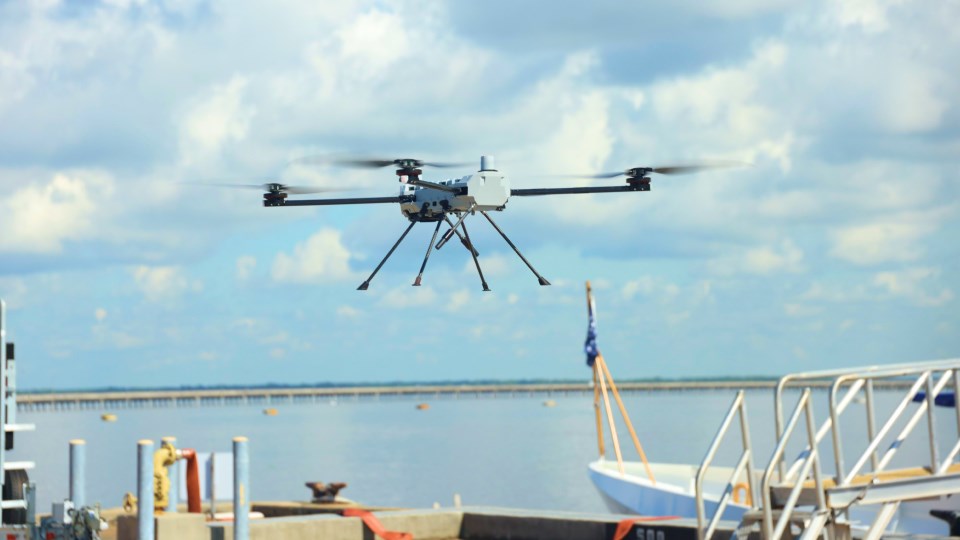
Aboard the Coast Guard Cutter Olivia Hooker in Pascagoula, Mississippi, PDW and Coast Guard personnel recently completed preliminary shipboard testing of the C100 sUAS. The evaluation demonstrated reliable aircraft performance in the cutter’s active radio frequency environment while successfully validating shipboard launch and recovery.
In recent months, the U.S. Coast Guard has awarded PDW two contracts for C100 systems, payloads, and operator training, establishing the foundation for an operational assessment of mission-ready unmanned aircraft for maritime operations.
PDW CEO James Slider stated: “The measure of a system isn’t when it’s delivered. It’s when operators begin putting it to work. That philosophy has shaped PDW’s growing relationship with the United States Coast Guard. Welcoming the Coast Guard to our growing customer base further demonstrates the C100’s ability to perform across diverse environments and mission sets without compromising reliability or capability.”
The evaluation was requested by the Coast Guard to determine whether the C100 could safely operate aboard a fast response cutter while the vessel’s primary radio frequency emitters remained fully energized. Testing also validated launch and recovery procedures, communications reliability, and overall aircraft performance.
The results demonstrated reliable aircraft performance throughout the event. The C100 experienced no electromagnetic interference, communications degradation, flight anomalies, or navigation issues while operating within the cutter’s active RF environment. The aircraft also completed successful launches and recoveries from the vessel’s all-steel flight deck.
Following the successful electromagnetic interference evaluation, Coast Guard operators used the C100 to conduct a 360-degree mast inspection, inspect the cutter’s hull, and provide aerial overwatch during an active towing evolution. One inspection that would normally require launching a small boat was completed in less than 10 minutes while collecting high-quality imagery.
Much of the flying was performed by Coast Guard personnel themselves. Operators highlighted the C100’s rapid setup, ease of operation, stable flight characteristics, and reliable communications. The aircraft was assembled, synchronized, calibrated, and airborne in less than 10 minutes.
Slider concluded: “Our goal has never been to build an aircraft for a single mission. It’s to build a robotic system operators can trust wherever the mission takes them. We believe this demonstration reinforced that the C100 can perform reliably in the demanding maritime environment while giving Coast Guard crews the flexibility to take on a wide range of missions from a single platform. That’s exactly how modern capability should work.”
