

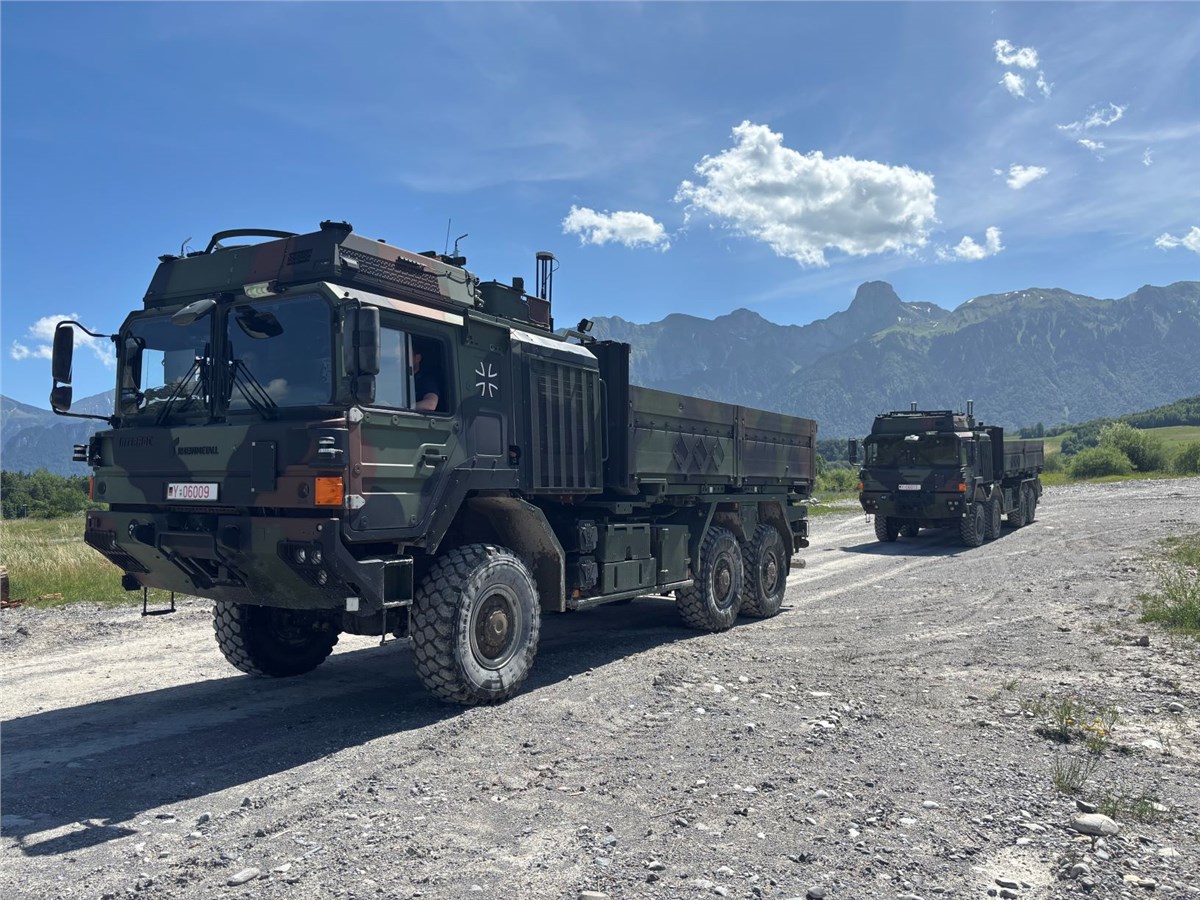
Rheinmetall MAN Military Vehicles has assumed full responsibility for the InterRoC VII (Interoperable Robotic Convoy VII) research project on behalf of the Federal Office of Bundeswehr Equipment, Information Technology and In-Service Support (BAAINBw). The project is aimed at advancing highly automated military logistics systems and supporting the digitalisation of military mobility.
The assumption of project responsibility comes shortly after Rheinmetall achieved a leading result in the “Convoy Scenarios” category at the 2026 European Land Robot Trial (ELROB), held at the Thun military training area in Switzerland. The international event provides a platform for demonstrating unmanned ground systems and autonomous robotic technologies under realistic military conditions. During the trial, Rheinmetall demonstrated autonomous logistics capabilities in demanding convoy and transportation scenarios.
Advancing Interoperable Robotic Convoys
InterRoC VII continues Rheinmetall’s work on the Interoperable Robotic Convoy research programme. The project focuses on developing highly automated convoy control and testing vehicle formations in which different platforms can operate together safely and autonomously.
Key areas include vehicle automation, environmental perception, autonomous decision-making and route planning for heterogeneous vehicle formations. These capabilities are intended to support reliable convoy operations in complex military environments, where different vehicle types and operational requirements need to be coordinated.
HX Vehicle Family Provides the Platform
The InterRoC VII project uses vehicles from Rheinmetall’s established HX family of military logistics vehicles. The platforms are equipped with Rheinmetall’s modular PATH sensor kit and drive-by-wire technology integrated into the vehicle architecture.
The open architecture allows additional sensors, artificial intelligence-based software and mission-specific algorithms to be incorporated as requirements evolve. This provides a scalable foundation for developing increasingly autonomous military logistics vehicles and adapting the systems to different operational scenarios.
Autonomous Operations in GNSS-Denied Environments
A major area of development is the ability to operate without reliable access to satellite navigation. Military vehicles operating in electronically contested environments may face disruptions or denial of Global Navigation Satellite System (GNSS) signals.
The technologies developed through Rheinmetall’s autonomous vehicle research are designed to allow vehicles to map their surroundings, determine their position and conduct convoy operations without depending exclusively on satellite navigation. This capability is particularly relevant to autonomous military mobility in environments where conventional navigation systems may be compromised.
Supporting the Digitalisation of Military Logistics
InterRoC VII forms part of the wider transformation of military logistics through automation and networked mobility. Highly automated logistics vehicles could support transportation missions while reducing the exposure of personnel to potentially hazardous environments.
The research also contributes to the development of digitally connected military mobility systems, where autonomous vehicles can operate as part of coordinated formations rather than as isolated platforms. Such capabilities could become an important element of future military logistics architectures.
Driveblocks Supports Autonomy and Perception
Driveblocks GmbH is contributing specialist software and artificial intelligence capabilities to the project, particularly in object classification and environmental perception.
The company develops modular autonomy and perception systems that combine camera and LiDAR sensor data with AI-based models. These technologies are designed for demanding off-road environments and have applications across defence, construction and agriculture.
Through InterRoC VII, Rheinmetall is continuing to develop autonomous military logistics technologies based on modular vehicle architectures, advanced sensing and AI-enabled decision-making. The project represents another step towards interoperable robotic convoys capable of operating across complex military environments and supporting the future digitalisation of military mobility.
